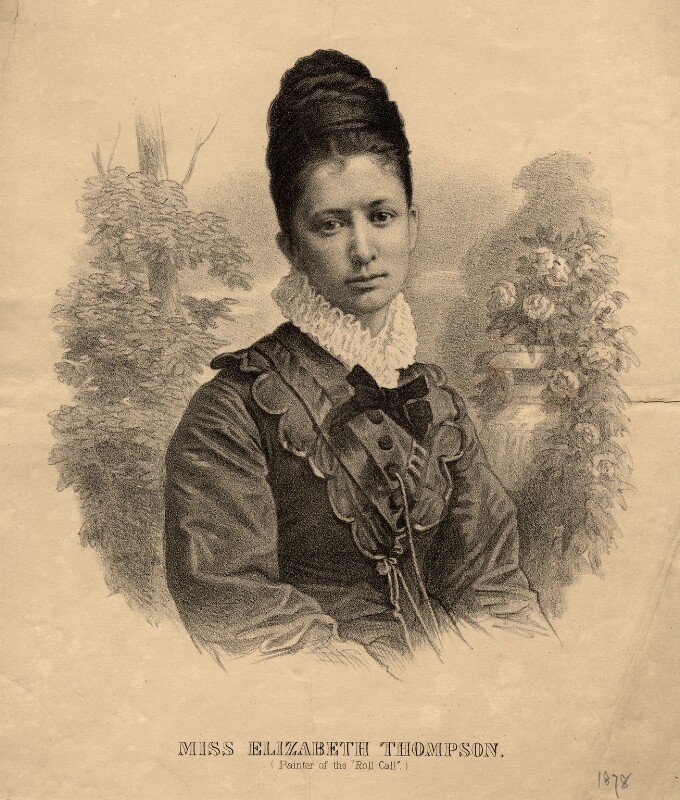
The distinguished artist and art critic John Ruskin, writing in his “Academy Notes 1875” about Elizabeth Thompson’s painting The Roll Call (full title Calling the Roll After an Engagement, Crimea) exhibited in 1874 at the Royal Academy, noted:
I never approached a picture with more iniquitous prejudice against it than I did Miss Thompson’s, partly because I have always said that no woman could paint; and secondly, because I thought what the public made such a fuss about must be good for nothing. But it is Amazon’s work this, no doubt of it, and the first pre-Raphaelite picture of battle we have had.
Ruskin’s initial disparaging approach towards women artists reflected the attitude of most artists, art critics, scholars and academicians of the nineteenth century regarding women; although the female body had been one of the most painted and celebrated subjects in art, women themselves were struggling to be recognised as artists. Their work was subjected to a static thematography expected of them by the establishment, which insisted on confining them to feminine subjects. Ruskin’s acceptance of Miss Thompson’s (later known as Lady Butler) excellence marked a breakthrough in recognising women’s position not only in the art world but their role in public life.
© Costas and Rita Severis Foundation
The 'Did you Know' series is supported by The Hellenic Initiative Canada.


